Cloud Burst Across the Himalayas – A Wake-Up Call for Climate Change.
By Padma Dolkar
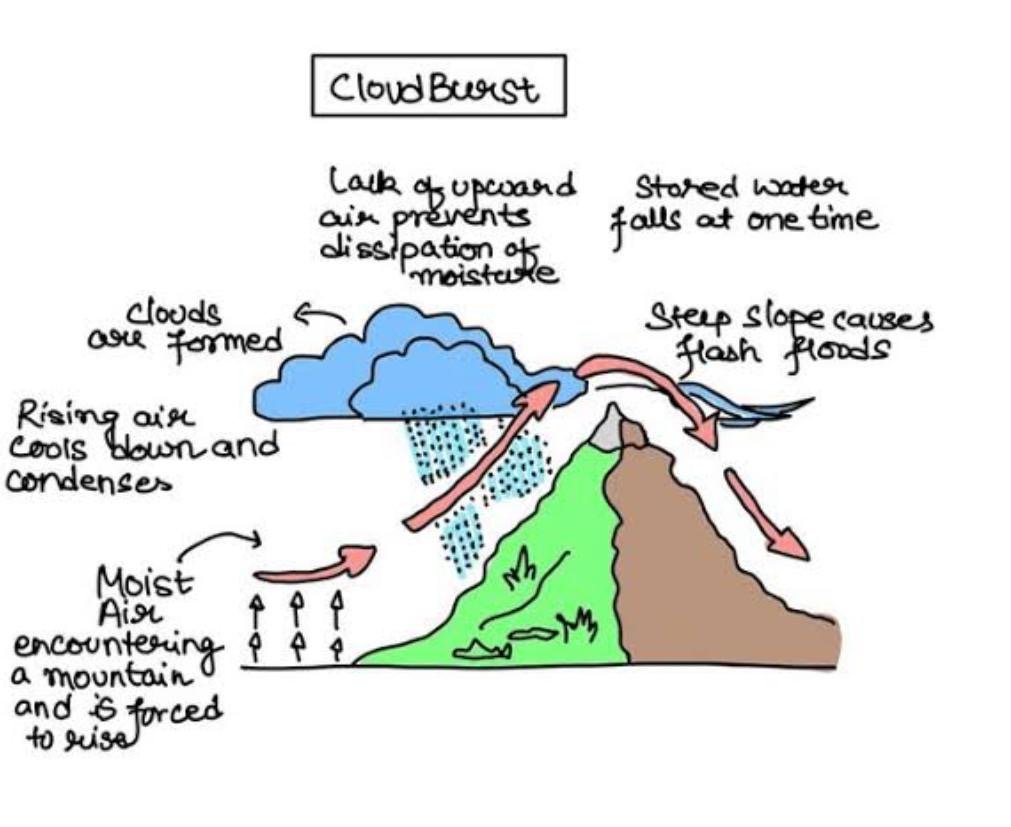
A cloudburst is an unexpected weather phenomenon characterised by heavy rainfall of about (100 mm or 10 cm )per hour in a small area of about (10–12 square km), leading to flash flood-like situations, especially in hilly areas due to their topography.
Unfortunately, several incidents were reported across the Himalayas in 2025. Numbers of cloudbursts and flash floods were also reported in Trans-Himalaya and Ladakh, leaving behind several destruction of infrastructure and crops across the region.
Natural Factors
1. Geographic Topography.
During the monsoon, winds carry warm, moisture-rich air from the sea. When this air meets the mountains, the terrain forces it to rise. As it climbs, the air cools and the moisture condenses, forming clouds and the process is known as orographic lift. When these clouds get trapped in valleys and reach their maximum water-holding capacity, they unleash heavy, sudden rain known as a cloudburst, creating orographic rainfall in the region.
Ladakh, being a dry, hilly, and cold desert area with low water absorption capacity, is highly vulnerable to such extreme climate disaster.
India usually experiences two monsoon wind systems:
Southwest Monsoon: Brings rains to almost all Indian regions from June to September, beneficial for Kharif crops.
Northeast Monsoon: Brings rains from October to December to southern India, including Tamil Nadu, Andhra Pradesh, and parts of Kerala, also called the retreating monsoon, helping Rabi crops.
Another factor that brings rainfall in India is the Western Disturbance, which is a short storm system that brings winds from the Mediterranean Sea to the northern regions of India. It occurs mainly during December to February and provides crucial rainfall and snowfall, which actually helpful for the growth of Rabi crops.
But this year, the Western Disturbance arrived earlier, and the Southwest Monsoon lasted longer than usual. And the overlapping of these two winds leads to extremely heavy rainfall across the country, particularly in northern regions. The result was seen as widespread flooding and destruction, especially in the Himalayan states (Himachal Pradesh, Uttarakhand, Jammu & Kashmir, and Punjab). Scientists also point to climate change and global warming as factors intensifying such extreme weather events.
Why Have Cloudbursts Become So Frequent Across the Himalayas?
The answer lies in climate change, driven by human intervention out of greed rather than natural causes.
Human Factors Contributing to Climate Change.
Unplanned Development: Tourism is the main source of economy in the regions like Ladakh, Jammu & Kashmir (especially in Kashmir), Himachal Pradesh, and Uttarakhand. So the area is being exploited for economic and commercial purposes with many unplanned and unnecessary projects, which severely affects the ecological balance of these area.
Deforestation and Mining: Large forest areas are being cleared for mining, development of highways, tunnels, and urban projects without considering the carrying capacity of these sensitive regions.
Unplanned Urbanisation: Excessive construction of commercial buildings, establishment of factories and industries, overuse of transportation, unregulated use of plastic waste and over-dependence on fossil fuels are accelerating the climate change and In the Himalayas, this is visible through frequent cloudbursts and flash floods .
Blockage of drainage systems in the city mostly in low-lying areas worsens the effect of floods and ultimately results in flooding. Another reason is the illegal and unregulated encroachment of riverbeds for sand extraction, which alters the river flow and contributes to floods during the monsoon.
Signs of Climate Change in Ladakh.
Changing Weather Patterns: Earlier, rainfall in Ladakh was light and slow, which usually helps to recharge the groundwater resources. And the incidence of cloudbursts was very rare. Now, the rainfall has turned into heavy showers, and snowfall has shifted from December–February to March–April. So, the heavy rainfall quickly leads to flash floods, especially during monsoons.
Temperature Fluctuations: Recently, the temperaturefluctuations have become extreme across Ladakh, as one day it feels like peak summer, and the next day it feels like mid-winter. And we have witnessed the heavy rainfall during the blossom season has destroyed many apricot crops this year.
Thinning of Glaciers: Glaciers are the only source of water in Ladakh, but many have already vanished, and several others are on the verge of disappearing, resulting in the formation of glacial lakes and Glacial Lake Outburst Flood ( GLOF) in the region.
Loss of Groundwater Resources: Glaciers play a crucial role in recharging groundwater, but over-extraction of groundwater resource is worsening the crisis. Unfortunately, many hotels and resorts are exploiting the groundwater for swimming pools and commercial purposes, and the rate of extraction is faster than the rate of recharge.
Can Ladakh Support This? What is the alternate source of water for Ladakh other than glaciers?
No, Ladakh cannot support such crisis, and it does not have any other alternate source of water.
Way Forward/ solution.
1. The fragile ecosystem of Ladakh requires urgent attention and sustainable solutions. It should begin with large-scale awareness drives at the ground level to spread awareness among people about environmental challenges and their role in protecting the region.
2.
There must be a strict policy to limit the number of vehicles, especially those coming from outside Ladakh, in order to reduce pollution. At the same time, a shift towards cleaner and renewable sources of energy such as CNG, solar heaters, and other eco-friendly technologies should be promoted. Providing subsidies and strengthening public transport can encourage people to adopt such alternatives.
3.
Strict restriction of unregulated exploitation of groundwater, unplanned urbanization, and unnecessary developmental projects must be enforced, as they pose a serious threat to the region’s delicate ecological balance.
4.
Community involvement plays a crucial role in this regard. Large-scale cleanliness drives, coupled with policies for tree plantation, waste management, recycling, and the use of eco-friendly products, should be implemented. Bhutan sets an inspiring example where planting a tree on each citizen’s birthday has become a tradition, such practices can be adopted in Ladakh to encourage afforestation.
5.
Learning from successful models is also essential. Indore, the cleanest city in India, provides a strong example of effective waste management, which can be replicated in Ladakh with required necessary modifications.
6.
Furthermore, all unnecessary developmental projects must be immediately stopped, as the land cannot support over-exploitation. Instead, the focus should be on promoting sustainable tourism, which not only supports the local economy but also preserves natural resources.
Conclusion
Climate change is not a joke, nor an act of God; it is real. The only thing we need to do is act collectively and urgently. It’s not too late; we still have time to make a change and be responsible before it’s too late.
“The Himalayan glaciers can stand tall for ages, but not against human greed.”
Save Himalaya, Save Glaciers.
Major Cloudbursts and Flash Floods in Ladakh(2025)
| S.no | Date | Location | Event Details | Damages (Source) |
| 1 | July 2025 | Purikchetay(Purigkargil) | Cloudburst and flash flood, bridge washed away, crop damaged. | Infrastructure and crop damage, no casualties reported. (Local source) |
| 2 | July 2025 | Shayok Valley | Cloudburst and flash floods affecting road connectivity across the region. | Roads buried under 2-3 meters of mud and debris, no casualties reported. (Local source) |
| 3 | Aug 2025 | Lamayuru and Bodhkharbu | Cloudburst and flash flood on Leh-Srinagar highway, disrupting traffic. | Road blocked, few households and crops damaged, few domestic animals swept away, no casualties reported. (Local source) |
| 4 | Aug 2025 | Mulbekh | Flash floods after cloudburst, Leh-Kargil highway blocked. | No casualties reported, only blocked highway. (Local source) |
| 5 | Aug 2025 | saspol | Cloudburst and flashfloods. | Road blocked, crops damaged. No casualtiesreported. |
Major Cloudbursts and Floods in Northern Region of India (2025)
You Can Send Your Views & comment’s at ;dolkarp40@ladakhjobswebgmail-com